For years travellers were warned to guard their wallets. Today the most valuable item many travellers carry is not cash at all. It is their smartphone.
A modern phone is effectively a traveller’s wallet, boarding pass holder, camera, map, translator, and travel planner all in one device. It may contain digital credit cards, airline tickets, cruise documents, hotel reservations, banking apps, and access to personal email accounts. Losing a phone is no longer just about the cost of replacing the device. It can disrupt an entire trip.
This is one thing you don’t want to lose, but if you do, it will happen quickly and you may not even notice immediately.
Because of this, phones have become the primary target for pickpockets and street thieves in many major travel destinations.
Police in London report tens of thousands of mobile phones stolen each year, with estimates commonly ranging between seventy and eighty thousand devices annually. That averages well over two hundred phones stolen every day. Across Europe, insurance industry data suggests roughly forty percent of reported mobile phone thefts occur in the United Kingdom, particularly in London’s crowded transit systems and tourist districts.
I am not picking on London, as there are other cities frequently associated with pickpocket activity including Paris, Barcelona, Rome, and parts of southern Europe where dense crowds gather around famous attractions, metro stations, and busy shopping streets. The pattern is similar in many large cities around the world. Anywhere travellers cluster together with phones in their hands becomes an attractive hunting ground for opportunistic thieves.
Staying Connected While Travellingis something more and more people are focused on. Our smartphones are our connection to the world in so many ways.
In recent years the method has also evolved. Traditional pickpocketing still occurs in crowds, but many thefts now involve quick “snatch and run” tactics. Thieves on bicycles, scooters, or even on foot may grab a phone directly from someone’s hand while they are texting or taking a photo.
For travellers, the phone has become one of the most valuable tools of the trip, so protecting it requires both digital security and simple situational awareness.
Recently as there have been events that have disrupted travel, your phone is a very important part if you are caught Travelling During Emergency Global Situations.
Before you travel, start with the basics of phone security.
Enable facial recognition or fingerprint authentication and use a strong passcode rather than a simple four-digit code. Turn on location tracking features such as Find My iPhone or Find My Device so the phone can be located or erased remotely if stolen. Make sure your photos and important data are backed up to the cloud so that losing the device does not mean losing your memories.
It is also wise to review the apps on your phone before leaving home. Remove apps you do not need for the trip and make sure payment apps require authentication before a purchase can be completed. Limiting what is accessible from your phone reduces the damage if it is stolen.
I am an Apple iPhone user through and through and I store nothing on my phone. Everything that I can access on my phone is accessed from my cloud storage. I use primarily Apple Pay, and that requires my facial recognition to activate. I have set up any critical App on my phone to require facial recognition to open.
Physical habits while travelling are just as important.
Keep your phone in a front pocket rather than a back pocket or open jacket pocket. Avoid placing it on café tables, restaurant counters, or bar tops where it can easily be picked up when you look away. In crowded areas such as transit stations, markets, festivals, or busy pedestrian streets, be especially aware of how visible your phone is.
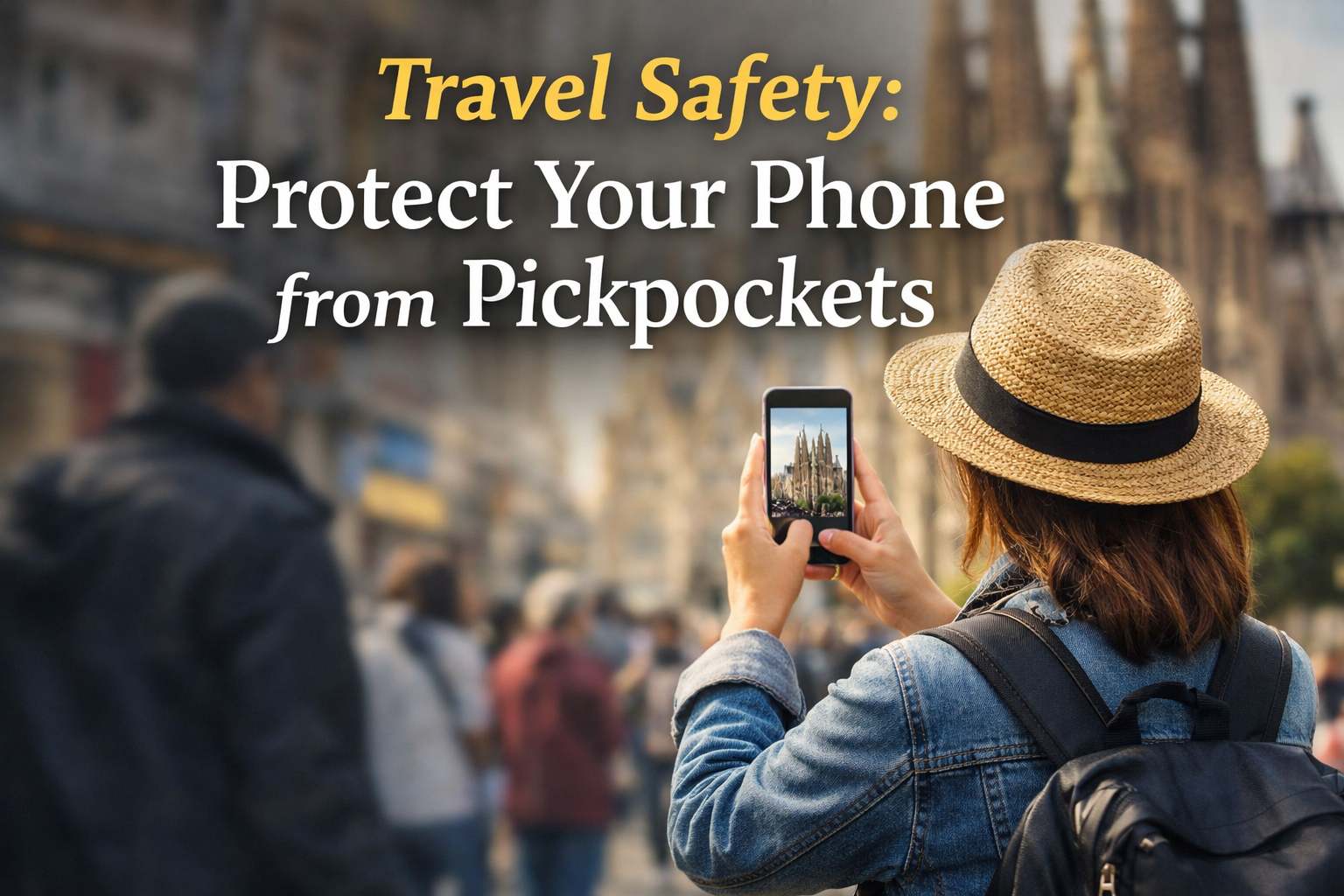
Travellers should also be careful when using their phone for photos. One of the most common moments for theft is when someone holds a phone out while taking a picture of a landmark or filming a video. If you are photographing something popular, step slightly away from the crowd rather than standing in the middle of the pedestrian flow. Keep a firm grip on the phone and stay aware of anyone moving unusually close.
Some travellers also use simple accessories that add protection, such as a wrist strap or lanyard attached to the phone case. These small additions can prevent a thief from simply grabbing the phone and running.
There are also a few habits that help reduce risk across any type of travel.
Avoid walking while deeply focused on your phone, especially when navigating directions in unfamiliar areas. Step to the side of the street or sidewalk to check your map instead of stopping in the middle of a crowd.
Be cautious when someone bumps into you or creates a distraction. Pickpocketing often relies on distraction tactics that shift your attention away from your belongings.
Finally, back up your phone regularly while travelling. If you take photos throughout the day, upload them to the cloud when you return to your hotel at night. That way, even if the device disappears, the memories of the trip do not.
For cruise travellers, the risk is typically limited to time spent ashore in busy ports and cities. Cruise ships themselves are generally controlled environments with security and limited access, however we should never assume that there is not an opportunist on our cruise ship if we provide the opportunity. The same awareness that applies in any busy tourist area applies during shore excursions or independent exploration in port cities.
The good news is that most travellers will never experience phone theft during their trips. But as smartphones become more central to how we travel, they have also become more attractive targets for thieves. A few simple precautions can dramatically reduce the risk and help keep your trip running smoothly.
I have personally seen the tactics pickpockets use while travelling. Awareness and vigilance have allowed me to avoid their attempts. In my experience, protecting your smartphone and valuables is not complicated. Most of the time it simply comes down to situational awareness - knowing where you are, what is happening around you, and paying attention to how you carry your belongings.
Ken Graham
Travel Advisor
TravelOnly With Ken