Plan Your Best Trip Ever!
"Bisseltown"

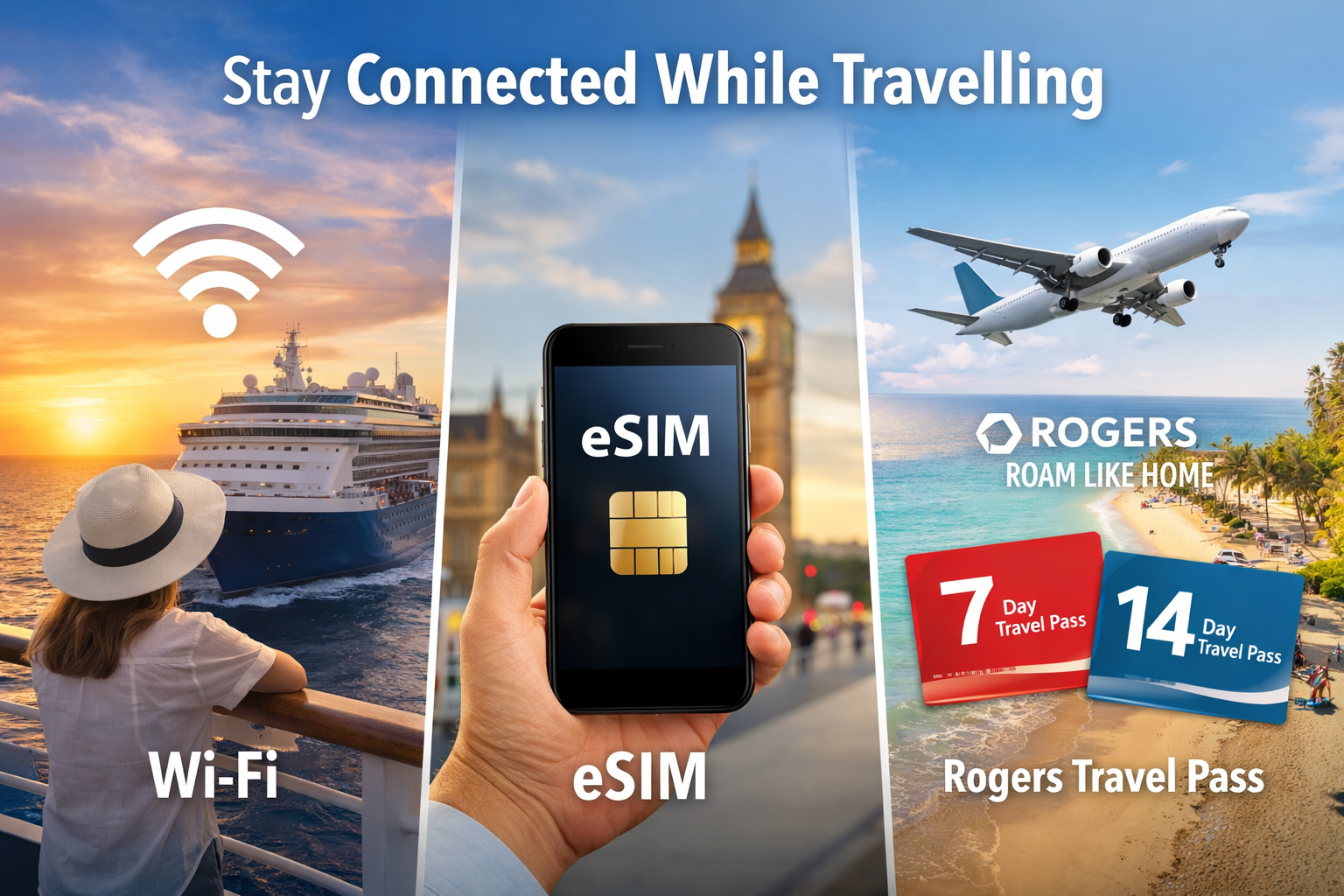
Over the years I have experimented with several ways to stay connected while travelling internationally.
The three most common options most travellers consider are:
Each option has advantages depending on how you travel and how connected you need to be.
Don’t give up on me here – keep reading because my current favourite is option #3 and I highly recommend this option as it gives ME the most functionality.
Option1 - Ship or Hotel Wi-Fi
Wi-Fi is usually the most basic connectivity option available to travellers. On cruise ships in particular, Wi-Fi packages have improved dramatically in recent years.
The pros to Wi-Fi is that it is available almost everywhere you stay, usually included or easy to purchase, and works well for messaging apps and email.
If your phone and provider allow, you can set your phone to Wi-Fi calling and with your roaming off, you can make and receive calls through Wi-Fi.
The cons to Wi-Fi are that the quality varies widely, calls and texts often require Wi-Fi calling or apps, and speeds can slow down when many guests are online.
Note that although connectivity is changing all the time, iPhone users – like me – suffer when iMessages are not coming through freely. Often this is the 2FA method, so I have switched where I can to email for 2FA.
When I am on an ocean cruise, once we are out at sea my cellular roaming typically does not work because we are too far from land, so at that point I must rely on the ship’s Wi-Fi package.
Most cruise lines now offer higher-tier internet packages that support Wi-Fi calling, which allows me to make and receive calls using my normal phone number if my device supports it – and my iPhone does.
Option2 - Data-Only eSIMs
eSIM travel plans have become very popular over the past few years.
The pros of data-only eSIMs are that they are often cheaper than traditional roaming, they are quite easy to install digitally before departure, and a great option for data, maps, messaging (Like WhatsApp), and browsing.
The cons of eSIMs for ME are most eSIM plans are data-only, meaning you cannot easily make or receive regular phone calls, you often cannot receive SMS text messages tied to your Canadian number, and some apps and two-factor authentication systems rely on SMS.
There are in fact eSIMs that offer voice calling but these are not currently linked to your home number and that is what I need. I cannot change my contact number constantly or my clients will get confused.
For most travellers who simply want Google Maps, WhatsApp, email, and social media, eSIMs can be a great option, but for someone in my role who must remain reachable by phone, they are not always ideal.
Option3 - Rogers Roam Like Home
A quick disclaimer: I am NOT being compensated for promoting Rogers new travel packages. I use them and they are affordable and a great option for me which is why I am talking about them.
The Rogers Roam Like Home has long been one of the simplest ways for Canadians to stay connected abroad.
With Roam Like Home, your phone connects to partner networks in more than 185 destinations, you use your existing Canadian plan’s data, talk, and text, and your phone number works normally for calls and messages.
The drawback for me has always been the cost. The daily fee is typically been upwards of $15 to $18 per day and on a 10-day trip if you want to have two phone connected, we are getting into serious cost above and beyond my monthly package..
NOW ENTER TO THE STAGE The New Rogers Travel Passes - And it is about time…
Rogers recently introduced Roam Like Home Travel Passes, which can significantly reduce costs for longer trips.
You can buy passes for 7, 14, or 30 days of roaming with one flat price instead of paying every day and they are available across multiple regions such as Europe, U.S., Caribbean, and many global destinations. I have an upcoming trip to Cambodia, Vietnam, and Thailand and will be there for 19-days and the 30-day package is so affordable saving me - literally - hundreds of dollars.
Travellers can also purchase these passes up to 60 days before their trip and choose the activation date, allowing them to plan ahead.
Here is an example of pricing that is currently advertised, and I am seeing 30-day Europe for $70.00 which would be 4’ish days at the daily rate. Longer passes can reduce the effective daily cost significantly.
Just remember that the pricing and promotions change frequently, so if you are within 60 days of travel and see a price that makes sense for your trip, it may be worth purchasing and scheduling activation before departure.
My Practical Strategy
In reality, I often use a combination of these options.
On land a Rogers Roam Like Home or a Travel Pass gives me the most reliable connectivity, as I can make and receive calls and texts normally.
At sea, or on a river, I rely on the ship’s Wi-Fi package and when on a river, often the Travel Pass can connect to a land tower, so I am using a combination. If the land connection is not available then Wi-Fi calling allows me to stay reachable if needed.
For many travellers eSIMs are often the most economical choice as you can let family and friends know that they can reach you via WhatsApp or Email. For someone like me who must remain reachable by phone I have to always play a game of combinations depending on if I am on land, a river, or an ocean.
A Word About eSIMs
How technical are you with your settings on your iPhone or other smartphone? Using eSIMs means you have to toggle this on, and that off, and the settings alone can become complicated, and then you arrive home to a roaming bill anyway. I have spent a lot of time studying these settings and even I find them confusing
The Bottom Line
There is no single perfect connectivity solution when travelling internationally. The best option depends on how long you are travelling, whether you need voice calls or only data, whether you will spend time at sea and your tolerance for managing multiple SIM profiles and combinations of connectivity options.
Fortunately, travellers today have far more connectivity options than we did even a few years ago.
As a final comment, I am not an expert on all of these options and I am constantly learning on how to use all these options. You do have to become very familiar with your phone options as they all require different settings than you use at home.
One of the reasons that I feel staying connected while travelling is so important, is because what would you do if you find yourself travelling during a global or regional emergency?
If you want to talk about connectivity and travel, get in touch.
#travelonlywithken #luxurycruising
View my personal travel experiences here: https://www.youtube.com/@TravelOnlyWithKen
"Bisseltown"
 Ken Graham
Sign up for our newsletter to learn about the latest product news and deals. Also receive exclusive offers, contest details and giveaways.