Plan Your Best Trip Ever!
"Europe Sud"

What the Current Canadian Rules Are
In Canada, the rules for power banks and spare lithium batteries align closely with international safety standards and are enforced by Transport Canada, with security screening carried out by the Canadian Air Transport Security Authority (CATSA).
Canadian regulations generally mirror the International Civil Aviation Organization (ICAO) and International Air Transport Association (IATA) guidance:
• Power banks and spare lithium batteries must be carried in carry-on baggage only.
• They are not permitted in checked baggage due to fire risk in the cargo hold.
• The maximum allowable capacity without airline approval is 100 Wh.
• Batteries between 100 Wh and 160 Wh may be allowed with airline approval, but approval must be obtained before travel.
• Batteries above 160 Wh are prohibited on passenger aircraft.
• Li-ion batteries should be individually protected (terminals protected) to prevent short circuits.
Canadian authorities are emphasizing clearer labeling, protection of terminals (e.g., tape over contacts), and compliance with Wh limits. If your external battery does not have a visible watt-hour rating, it may be removed or confiscated during security screening.
While Transport Canada does not encourage banning power banks, enforcement at screening may feel more stringent — especially if the device’s capacity is unclear.
What the Current U.S. Rules Actually Are
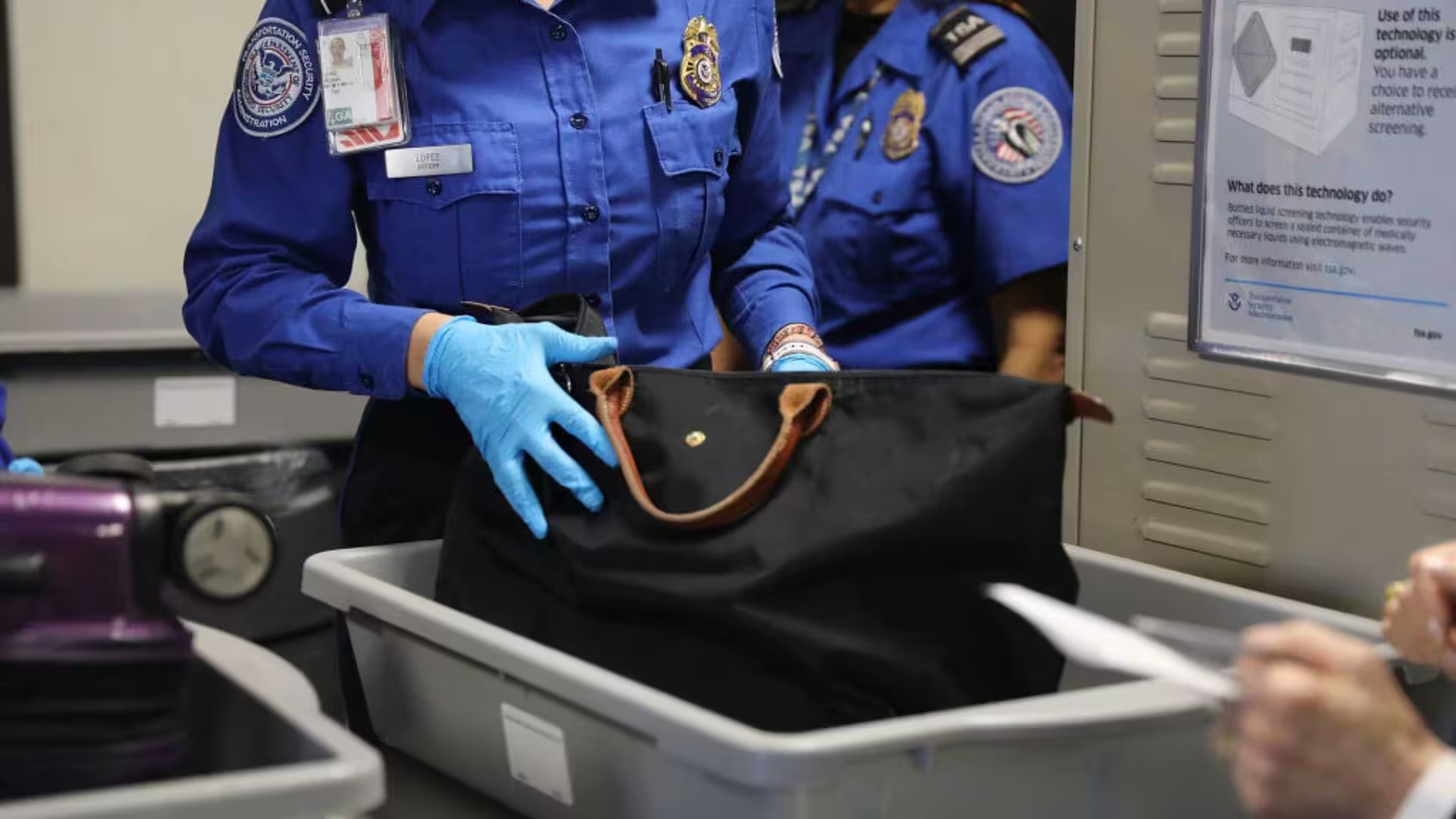
In the United States, lithium battery rules are guided by the Federal Aviation Administration (FAA) and enforced by the Transportation Security Administration (TSA).
Key points:
• Power banks are allowed only in carry-on baggage.
• They are not permitted in checked luggage under any capacity.
• The maximum capacity allowed without airline approval is 100 watt-hours (Wh).
• Most consumer power banks under ~27,000 mAh fall under that limit, but not all.
• Devices should clearly show a watt-hour rating (or voltage + mAh so wh can be calculated).
If a battery:
• Exceeds 100 Wh,
• Is not clearly labeled with its watt-hour rating,
• Or is placed in checked baggage,
it may be flagged, delayed, or confiscated at screening.
Despite stricter enforcement, TSA has stated that power banks are not banned, and passengers may carry compliant ones in their carry-on. However, increased scrutiny means screening officers may manually inspect any external battery that is not clearly marked or appears high-capacity.
Important: Some Airlines Are Already Stricter
Travelers, especially those flying to and from Asia, should be particularly aware that many airlines in South Asia, Southeast Asia, and East Asia enforce stricter policies than Canadian or U.S. rules.
Common airline restrictions include:
• Limits on the number of power banks allowed per passenger.
• Requirements that power banks be individually protected and clearly labeled.
• Prohibition of in-flight use of power banks.
• Ban on charging devices (phones/laptops) with external batteries during the flight.
In some countries, airlines have rules that go beyond the base regulations — for example, disallowing the use of a power bank to charge devices while in the air. Many carriers in Japan, Singapore, South Korea, Malaysia, India, Thailand, and the Philippines now have published policies detailing capacity limits and in-flight restrictions.
Before departure on these or other international carriers, check the airline’s own lithium battery policy — policies can vary significantly by airline and change without notice.
What This Means for You as a Traveler
Here’s how to avoid problems at security and on your flight:
1. Keep Your Power Bank in Your Carry-On
Never pack it in checked luggage. Mistakes happen, and even one misplaced battery can lead to delays or confiscation.
2. Check the Capacity Rating
Look for the watt-hour (Wh) rating on the battery. If it’s missing, weak, or worn off, it may trigger inspection or removal.
• If you only see mAh and voltage:
→ Wh = (mAh ÷ 1000) × voltage.
→ Example: A 20,000 mAh battery at 3.7V ≈ 74 Wh.
Any battery over 100 Wh requires airline approval (U.S./Canada), and some carriers may not accept it at all.
3. Terminal Protection
If terminals are exposed, cover them with tape or keep in original packaging to prevent short circuits.
4. Assume Usage Restrictions May Expand
Just because power banks are allowed today doesn’t mean their use will be permitted in flight tomorrow. Some airlines already disallow powering devices with external batteries while airborne.
Board with devices:
• Fully charged
• Backed up
• Ready to go
Rely less on the power bank as your primary in-flight power source.
Why Airlines and Regulators Are Taking This Seriously
Lithium-ion batteries are used in most modern electronics, but they carry fire risk:
• Thermal runaway can cause fire.
• Fires in cargo are harder to contain.
• In-cabin fires allow quicker response by crew.
Because of this risk, regulators tend to enforce strictly, even before formal regulatory changes occur.
Increased attention at security checkpoints is a proactive safety measure, not a punitive one.
Practical Travel Advice Going Forward
Before your next flight:
• Confirm your battery is under 100 Wh or approved by the airline.
• Confirm the rating is clearly labeled.
• Pack it in your carry-on only.
• Protect terminals.
• Fully charge essentials before boarding.
Before international flights — especially in Asia:
• Review the airline’s lithium battery policy
• Check whether power bank use is permitted in-flight
• Avoid high-capacity chargers unless absolutely necessary and clear them with the airline first
The Bigger Travel Planning Reality
Today’s travel relies on technology:
• Boarding passes
• Flight updates
• Immigration eVisas
• Apps for hotels and rides
Smart travelers adapt by:
• Charging devices before departure
• Bringing compliant equipment
• Knowing airline and country policies before flying
This approach is about preparedness, but also understanding that these restrictions can change at any time, and even if your power bank would be compliant today, it does not mean it will be compliant tomorrow.
"Europe Sud"
 Ken Graham
Sign up for our newsletter to learn about the latest product news and deals. Also receive exclusive offers, contest details and giveaways.