The advertised cabin fare is only the beginning. Here's what savvy travellers budget for — and why two cruises at the same "price" can end up worlds apart.
The Story That Starts Every Conversation
I think about a client I'll call Sandra. She called me a couple of years ago, genuinely excited. She had found what she described as a fantastic deal on a cruise on a well-known mainstream line, seven nights in the Mediterranean, and the headline price looked terrific compared to what she had seen from Viking. In fact, it was several hundred dollars per person less. She wanted to know why I kept recommending Viking when this other option looked so much more affordable.
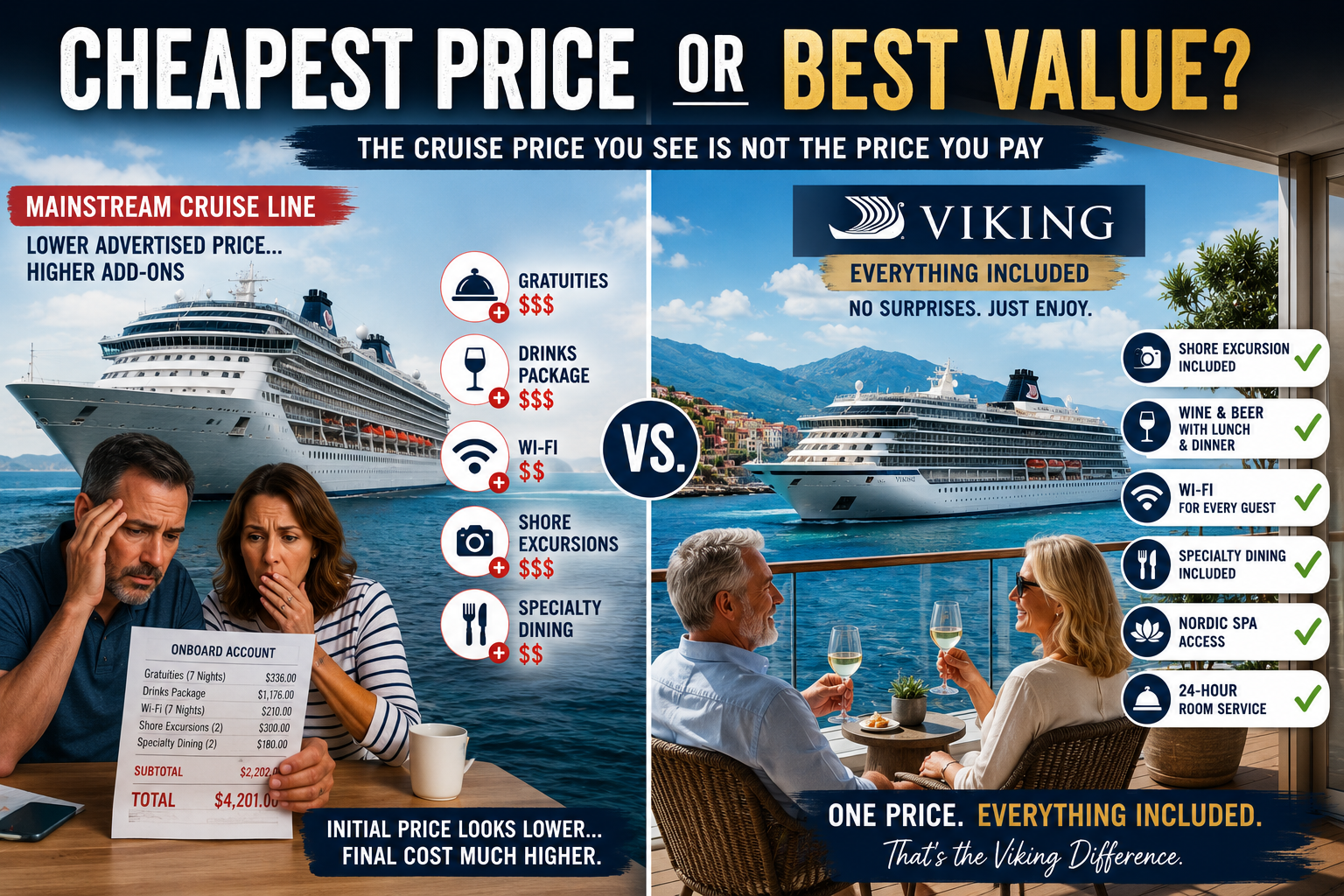
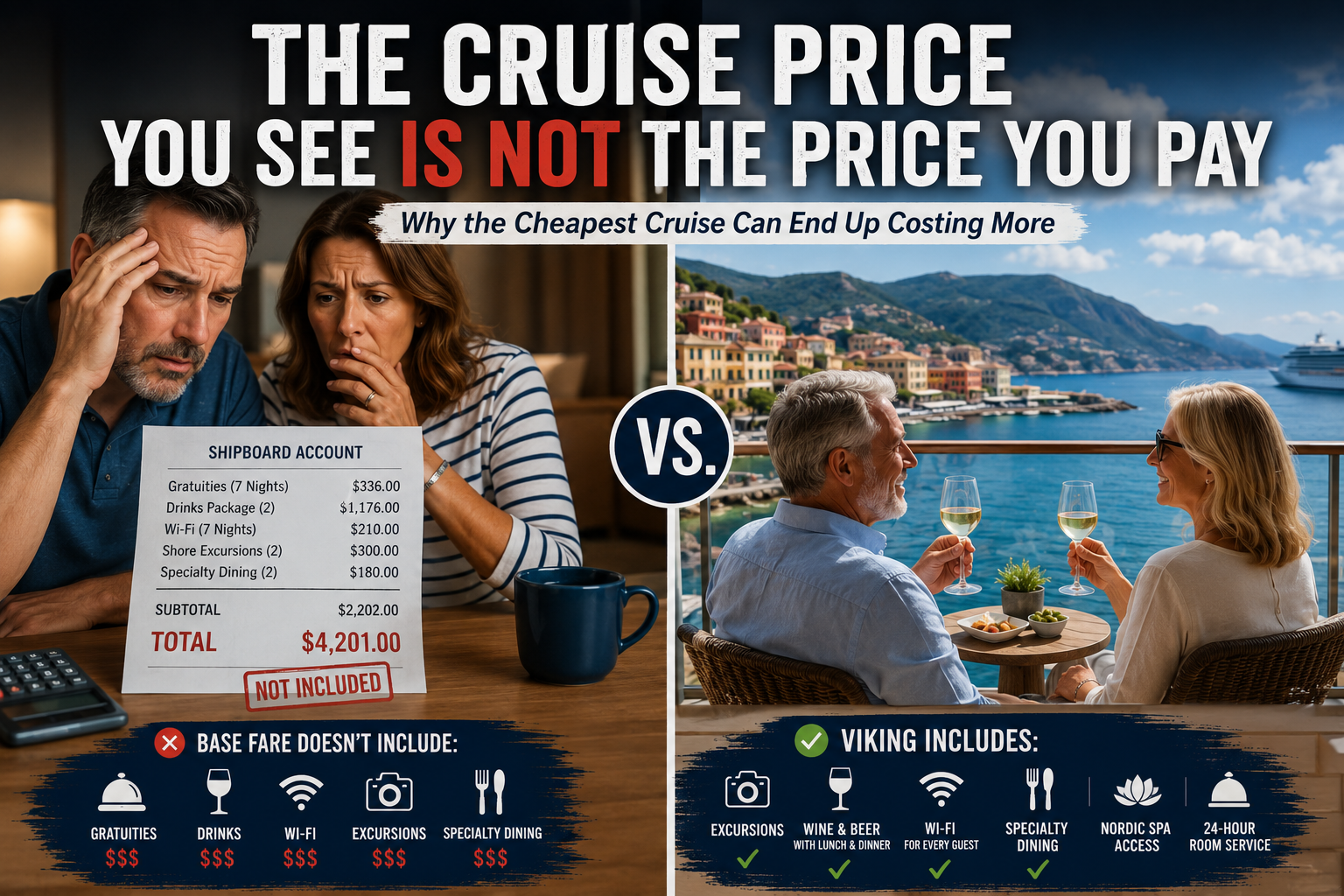
I asked her to pull up the booking page and walk me through it. By the time we finished, we had added the gratuities, the drinks package (because she and her husband enjoy wine with dinner), the Wi-Fi (she needed to check in on her business), two shore excursions, and specialty dining on two evenings. The total had climbed by more than $2,000 for the two of them. The "bargain" cruise was now priced within a few hundred dollars of the Viking sailing — which had already included all of those things, except gratuities. Viking can however have sailings where gratuities are included as a perk.
Sandra booked the Viking cruise.
I tell this story not to be clever, but because it is the most common conversation I have with new clients. The advertised price and the real price are rarely the same thing, and understanding the gap between them is the single most important step in comparing cruise lines honestly.
Why the Gap Exists
Cruise lines have two fundamental pricing models, and most travellers do not realize they are choosing between them.
The first is what I call the base-fare model. You buy a cabin, and everything else is available at an additional charge. Drinks, gratuities, Wi-Fi, excursions, specialty restaurants — all of it goes on your onboard account. You settle up at the end of the sailing, sometimes to considerable surprise. These are typically the fares that generate the eye-catching promotional prices you see in advertisements.
The second is the inclusive model, where the headline fare already wraps in many or all of those items. Lines like Viking, Regent Seven Seas, and Silversea operate this way. The upfront number looks higher, but the end-of-voyage bill is dramatically smaller — or in some cases, essentially zero beyond a few personal choices.
The important thing to understand is that neither model is inherently dishonest. The problem arises when travellers compare a base fare from one line with an inclusive fare from another and conclude that one is simply cheaper.
Many of my clients are not aware of how to navigate inclusions vs. exclusions in the pricing model. This is where I truly come into the picture as your cruise specialist. I have to admit, as I navigate the different cruise lines, I have to keep careful notes of what is and is not included.
What Gets Added On
Let me be specific, because the numbers matter.
Gratuities are the most consistently overlooked add-on. Most major mainstream cruise lines now charge a daily service fee added automatically to your onboard account. Depending on the line and cabin category, this typically runs between $17 and $25 per person, per day, and often including the children in the cabin as well. On a seven-night sailing for two people, that alone is $238 to $350 before you've ordered a single drink or stepped off the ship.
Drinks are next. If you enjoy wine with dinner, beer at the pool, or a cocktail in the evening, a drinks package is almost a necessity on base-fare lines. These packages run from roughly $60 to $105 per person, per day, depending on the level you select, and most lines require both passengers in a cabin to purchase the same package. On a seven-night cruise for two, that is a meaningful line item. NOTE that Viking's SSBP - Silver Spirits Beverage Package - is much more affordable if you want more than wine and beer at meals.
Wi-Fi is no longer a luxury — for most travellers it is an expectation, particularly those who are partially managing work or family responsibilities from the ship. Cruise ship Wi-Fi packages typically run between $15 and $30 per person, per day, again depending on speed tier.
Shore excursions can surprise people most of all. While many travellers intend to explore ports independently, the reality is that cruise line excursions offer convenience and reliability, particularly at ports where independent transport is complicated or time is limited. Budgeting $75 to $150 per person per port for organized excursions is a reasonable starting point for planning purposes. I have seen excursions to to $300, $400 + per person too.
Specialty dining adds another layer. The main dining room is always included, but signature restaurants aboard many ships carry per-person surcharges ranging from $30 to $80 or more per evening.
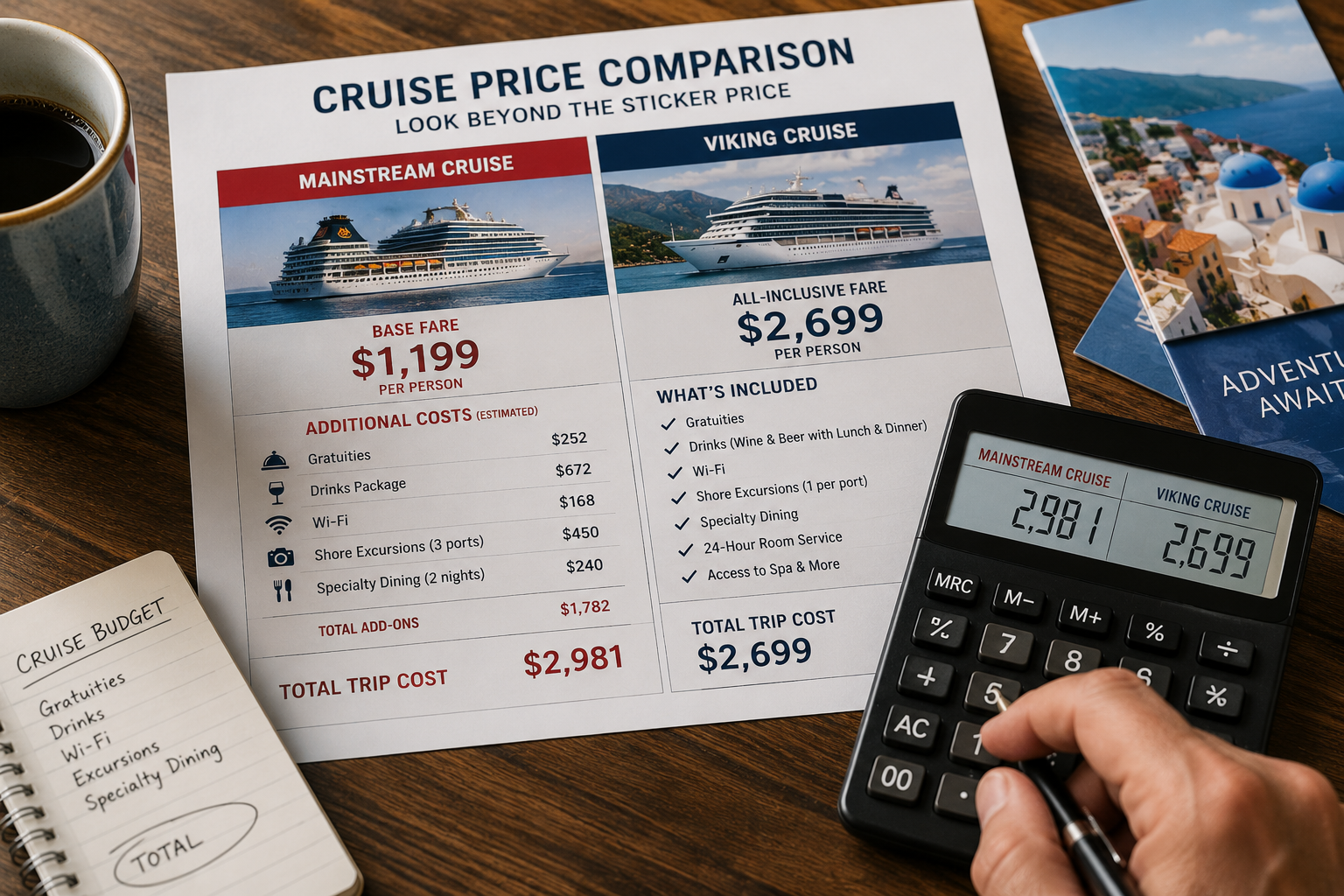
Add these together across a week at sea for two people, and the supplementary costs can easily reach $2,000 to $3,500 on top of the base cabin fare — sometimes more.
The Viking Comparison That Changes Everything
I use Viking as a reference point frequently because their model makes the comparison concrete.
Viking includes, within the standard fare, a shore excursion at every port of call, all onboard dining including specialty restaurants, beer and wine served with lunch and dinner, specialty coffee and soft drinks throughout the day, Wi-Fi for every passenger, access to their Nordic spa facility, and 24-hour room service. Their entry-level stateroom is a balcony cabin with a private veranda.
When a client shows me a Celebrity or similar itinerary priced several hundred dollars lower, my first question is always: have you priced in gratuities, drinks, Wi-Fi, and at least one excursion per port? When we do that arithmetic together, the gap narrows considerably. In some cases it disappears entirely. In others, the Viking fare is actually the better value — and in every case, the Viking experience comes without the ongoing decisions about what to spend and what to skip.
One detailed analysis comparing a seven-night Viking Mediterranean cruise with a similarly routed sailing on Celebrity found the final all-in costs within a few hundred dollars of each other — despite the Viking base fare appearing significantly higher at the outset. That several-hundred-dollar difference bought an entirely different experience: smaller ship, guaranteed balcony, no nickle-and-diming, and the simple pleasure of knowing your holiday cost was settled before you left home.
Sale Fares and What They Often Mean
The promotional cruise fares you see advertised deserve particular scrutiny.
Sales are real, and genuine savings are available — particularly when booking early or taking advantage of limited-time companion promotions. But the lowest fare in any sale is typically the most stripped-back option. On some lines, it may mean a guarantee cabin where your specific stateroom is not assigned until check-in. It almost always means a base fare with no inclusions, requiring you to add on everything separately, usually at a higher per-item cost than if you had booked a bundled package at the time of reservation.
This is not a criticism of how cruise lines market themselves. It is simply how the industry works, and knowing it changes how you should read any promotional price you encounter.
The honest question to ask of any cruise fare is not "what does it cost?" but "what does it include?" Those are two very different questions with two very different answers.
Now, I have clients that don't want a drinks package, and want to disconnect while onboard with NO Wi-Fi. This makes a contemporary cruise line more attractive, because let's face it, the lines that include these things - if you don't want or need them - are in fact inside that price. It is when you DO want these add-ons that it can make the difference.
What Truly Inclusive Looks Like
For context on what full inclusions mean at the upper end of the market, lines like Regent Seven Seas and Silversea operate on a genuinely all-in basis — unlimited shore excursions, all drinks, all dining, Wi-Fi, gratuities, and in some cases business class airfare. The per-person fares are higher, but for many travellers the arithmetic still makes sense when compared with adding every item separately on a base-fare line.
Viking sits one tier below this, offering what I would describe as nearly all-inclusive at an attainable price point. The only meaningful extras on a standard Viking sailing are premium wines and spirits (an optional package is available), spa treatments, and any additional excursions beyond the complimentary port tour. Gratiuities are also extra on a Viking sailing unless there is a promotion that includes gratuities.
A Practical Approach Before You Book
Before you decide that one cruise is more affordable than another, I'd encourage you to work through a simple exercise.
Take the advertised fare and add: daily gratuities for the full sailing, a drinks package appropriate to how you actually travel, Wi-Fi if you need it, one shore excursion per port of call, and any specialty dining you'd realistically enjoy. Write that number down.
Then look at an inclusive fare on a line like Viking, and write that number down.
In my experience, the two numbers are far closer than the original advertising suggests — and sometimes the "expensive" option turns out to be the better value.
If you'd like me to do that calculation with you for a specific sailing you're considering, I am genuinely happy to help. It's one of the most useful things a travel specialist can do, and it costs you nothing to have the conversation.
The Bigger Picture
Cruising remains one of the most extraordinary ways to see the world. Multiple destinations, unpacked once, with exceptional food and service included — the core value proposition is real.
But the value only holds if you're comparing the right numbers. A holiday that looks like a bargain and arrives as a surprise is not a bargain.
The travellers I see enjoy their cruises most are the ones who understood what they were getting before they stepped aboard — no mental arithmetic at dinner, no reluctance to join an excursion because of the cost, no bill at the end of the week that changes how they feel about the trip.
That's the experience I aim to help you plan. If you have a cruise in mind and you'd like an honest, detailed look at the true cost before you commit, reach out. I'm here to make sure the price you see is the price you can actually count on.
Ready to compare the real numbers? Whether you're weighing a mainstream sailing against an inclusive line, or simply want to understand what a particular voyage will actually cost from departure to return, I can help. Contact me at TravelOnly With Ken and let's have that conversation before you book.
I am Ken Graham - TravelOnly With Ken - Travel Advisor and Cruise Specialist