Plan Your Best Trip Ever!
"Toronto"


A friend recently came to me to book a hotel room. Like a lot of travelers, this person had spent years assuming that the big, heavily advertised booking sites always had the best price available. So before booking with me, the same friend checked one of the most popular online travel agencies, the kind that runs television ads telling you that you should have checked them first. Then the friend checked with me, the travel advisor. I beat the rate. In other cases, depending on the hotel and the dates, I have been able to at least match if not beat the reate. That is not a one off story. It happens often enough that it says something about how the online travel industry is built, and about the gap between the price you expect to get and the price you actually get.
None of this is meant as an attack on online travel agencies, often shortened to OTAs, as a category. They serve a real purpose, they are convenient, and for certain trips they are a perfectly reasonable way to book. The issue is narrower than that. It is the marketing message that says you will always get the best deal by booking through them, and that anyone who checked somewhere else, including a human advisor, simply did not look hard enough. That message is not accurate, and the data backs this up.
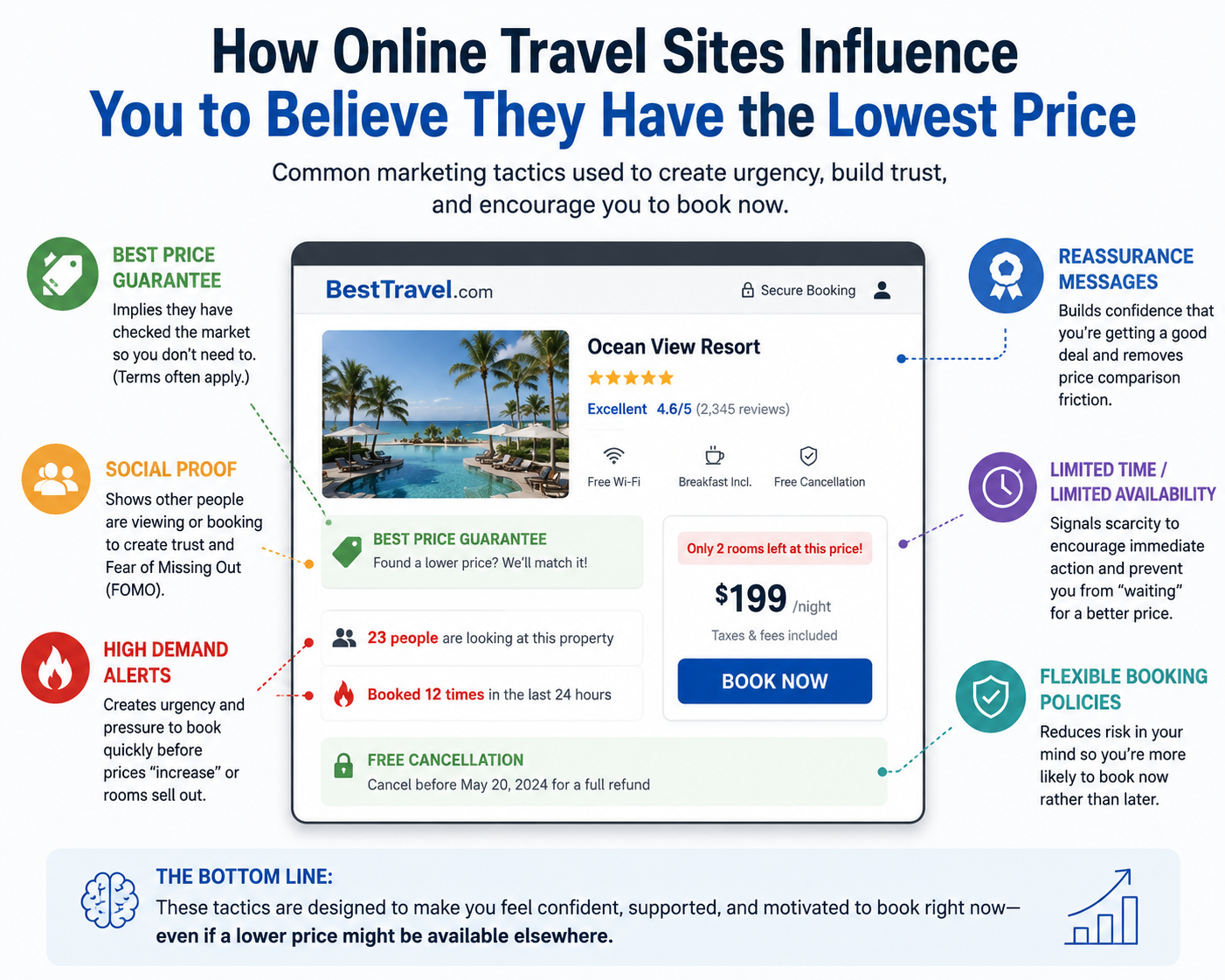
The belief that online travel sites are the cheapest option did not happen by accident. It is the direct result of enormous marketing spend designed to create exactly that impression. The global online travel booking market is projected to reach a valuation of roughly seven hundred billion US dollars in 2025, growing at a compound annual rate of about ten and a half percent through 2034. That kind of market size supports advertising budgets most individual travel agencies and even most hotel brands cannot come close to matching.
That advertising works because it taps into something psychologically real. Travellers increasingly research and book using online travel agencies, with about eighty percent of global travellers visiting these platforms within forty five days before making a purchase, and in 2023, fifty one percent of travellers booked through an online travel agency, compared to thirty seven percent who booked directly with an airline and twenty three percent who booked directly with a hotel. When a huge share of the traveling public starts their research on the same handful of sites, and those sites are the ones running the slogan about checking elsewhere, the slogan starts to feel like an established fact rather than a marketing line.
There is also a stickiness effect once someone starts using a particular site. Eighty percent of users booked with a single online travel agency in 2023, while only seventeen percent used two different platforms, which suggests that once people settle on a familiar app or website, they stop comparison shopping altogether. That is precisely the behaviour the big advertising budgets are designed to produce.
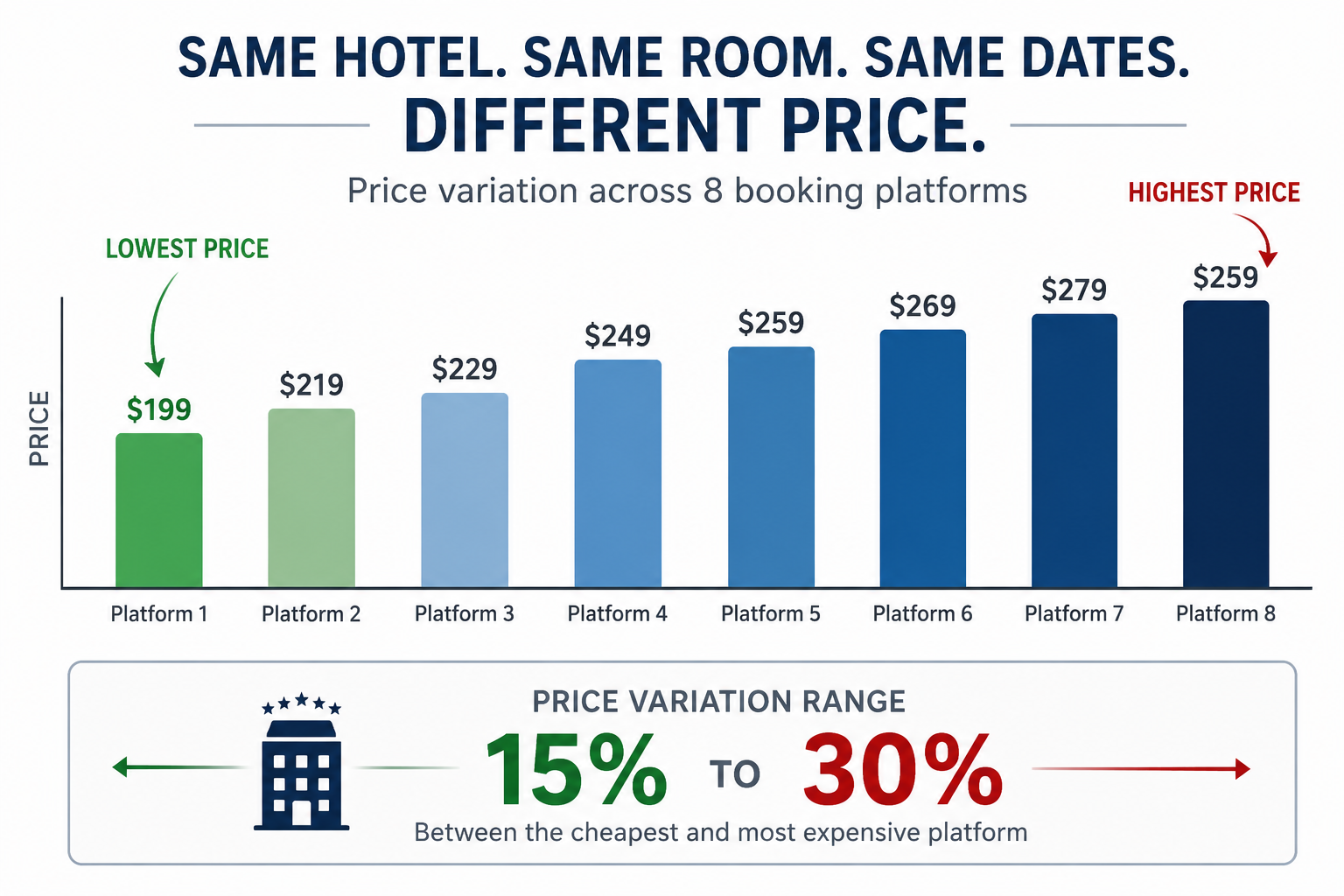
The first crack in the always cheapest narrative is that prices vary far more across booking platforms than most travelers assume. One detailed comparison of fifty identical hotel and resort booking requests across eight different platforms found price variations of fifteen to thirty percent between the cheapest and most expensive platform for the exact same hotel and dates. If the spread between platforms can swing that widely, the idea that any single site is reliably the cheapest option for every booking simply does not hold up.
The second crack involves something the hotel industry calls rate parity. Hotel rate parity is the practice of keeping a property's rates consistent across every distribution channel, from online travel agencies to the hotel's own direct website, and online travel agencies typically collect a commission of around ten to thirty percent of the room rate after a guest checks out. Here is the part that matters for travellers: when a hotel has to pay a sizeable commission to a major OTA, and that OTA contractually requires the hotel not to undercut its advertised price anywhere else, the hotel has very little room to offer a meaningfully lower rate through any other channel, including a travel advisor working from a similar wholesale arrangement. In practice, this often means a knowledgeable advisor is not fighting an uphill battle to beat the OTA price, they are simply working from the same base rate without the layer of commission padding built into the advertised "deal."
Direct booking economics push in the same direction. OTA commissions typically run fifteen to twenty five percent per booking, while a reservation made directly with the hotel generates pure revenue for that property. Hotels know this, which is part of why many of them are willing to match or improve on a rate when a guest, or an advisor working on a guest's behalf, books through a different channel.
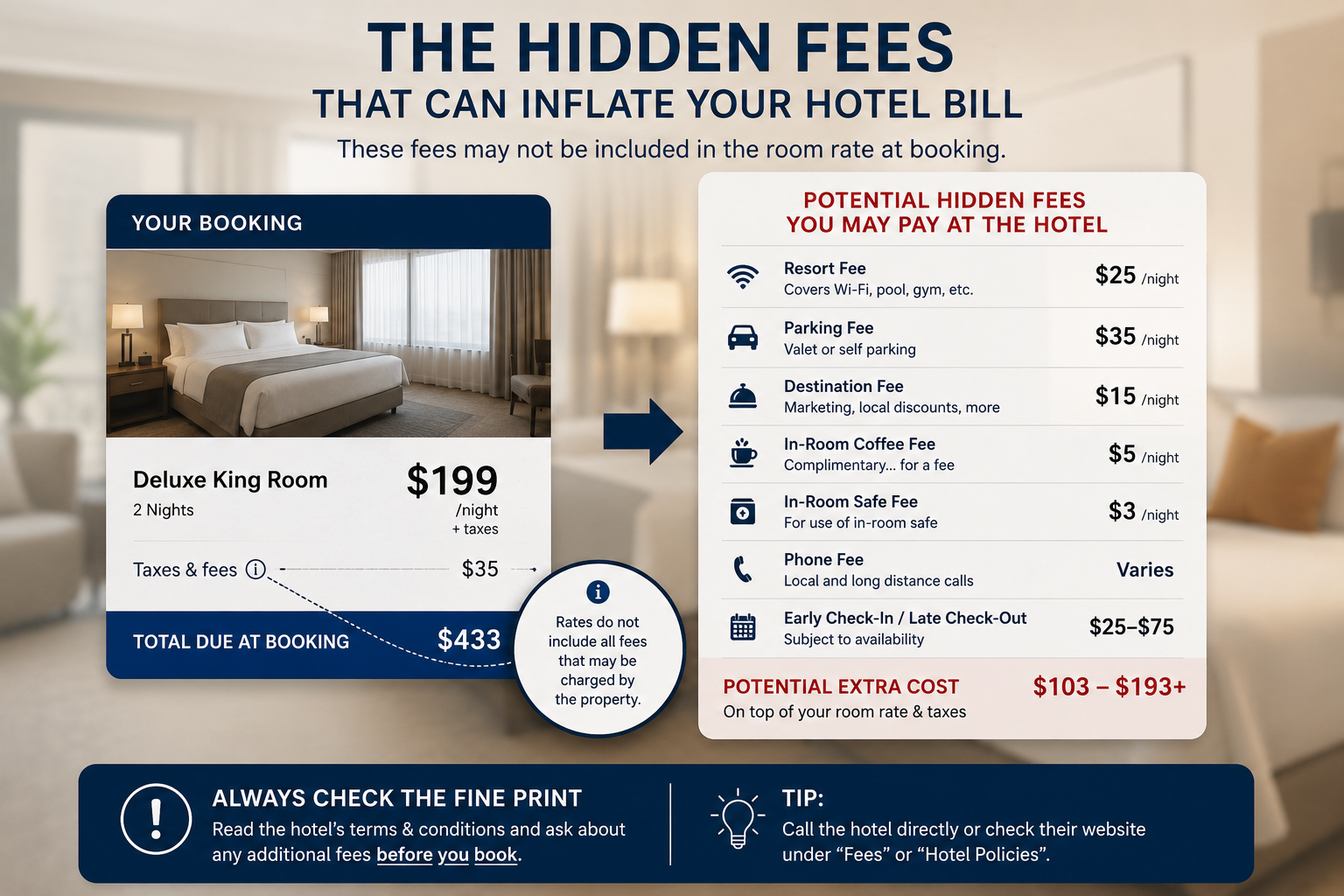
Then there is the matter of fees that do not show up in the headline price. In May 2012, the United States Federal Trade Commission held a conference on drip pricing focused specifically on resort and hotel fees added after a consumer arrives to check in, and following that conference, the FTC sent warning letters to twenty two hotel operators stating that their online reservation sites may be providing a deceptively low estimate of what a consumer will actually pay. The same FTC letters noted that mandatory resort fees for things like internet access or pool and gym use can run as high as thirty dollars a night, a figure that can clearly influence a traveler's purchasing decision, and that consumers often did not realize they would owe these fees until after booking. A price that looks like the best deal on the search results page can look quite different once those mandatory extras are added at checkout.
As a Travel Advisor, I am aware of these fees when you are booking. My booking sites highlight the full price inclusive of the fees payable to the hotel at checkout, so when I am quoting you a nightly rate, that fee is already accounted for.
This is where the personal story at the start of this article becomes more than an anecdote. A travel advisor who is doing the job properly is not guessing at pricing or relying on loyalty to a single platform. The advisor checks the same publicly advertised rates the traveler would see, then compares them against negotiated rates, supplier relationships, and sometimes promotions that are not published on a consumer facing website at all.
That does not mean an advisor wins every single comparison. There will be cases where a particular OTA promotion, a flash sale, or a loyalty discount produces a lower number than anything available through a traditional advisor channel. The honest claim is not that advisors always beat the big sites. It is that a good advisor checks the discount sites on every booking and, more often than not, comes back with a price that is the same or better, while also adding a layer of service, problem solving, and accountability that a self serve website does not offer when something goes wrong with the trip.
It is also worth noting that travellers themselves are increasingly recognizing this value. Travel agencies are projected to grow their market share by about five points by 2026, while OTA market share is projected to dip slightly over the same period, and the American Society of Travel Advisors reported in 2023 that half of travellers said they were more likely to use a travel advisor than they had been in the past. Thirty four percent of Millennials say they would book with a travel advisor over an online travel agency, and sixty percent of Millennials say they would be willing to pay more for an advisor's advice, recommendations, and destination knowledge. That shift did not happen because advisors got better at marketing. It happened because enough travellers had an experience similar to the one described at the start of this article, where checking both options revealed that the advertised deal was not actually unbeatable.

None of this means online travel sites are a scam or that travellers should avoid them. They are a legitimate part of the travel ecosystem, they are convenient, and for simple, flexible bookings they can absolutely be the right tool. What this does mean is that the phrase "you should have checked us first" deserves some healthy skepticism. The price you see on the search results page is shaped by marketing budgets, commission structures, rate parity agreements, and sometimes fees that only appear at the end of the booking process. None of those things automatically make the OTA price the lowest one available.
The simplest takeaway is the one buried in the original story. Check more than one source before booking, whether that second source is a different OTA, the hotel directly, or a travel advisor who is willing to do the comparison for you. The data suggests that the spread between options is often large enough to be worth the extra few minutes, and in plenty of cases, the advertised deal is not the only deal in town.
The statistics in this article come from multiple sites and I am happy to supply them to anyone who cares to ask. The main message that I want to get across is that as a Travel Advisor, this is the reality that I experience everyday and I DO check the OTA's and find that my price is the same or better. I HAVE recommended that clients that are cost conscious book directly on other sites, however most of my clients still keep the booking with me.
I am Ken Graham - Travel Advisor and Cruise Specialist
TravelOnly With Ken
"Toronto"
 Ken Graham
Sign up for our newsletter to learn about the latest product news and deals. Also receive exclusive offers, contest details and giveaways.