How Physically Demanding Is an Arctic Expedition Cruise? This article is
A practical look at how physically demanding Arctic expedition cruising really is, and why most travellers find it fa... learn more

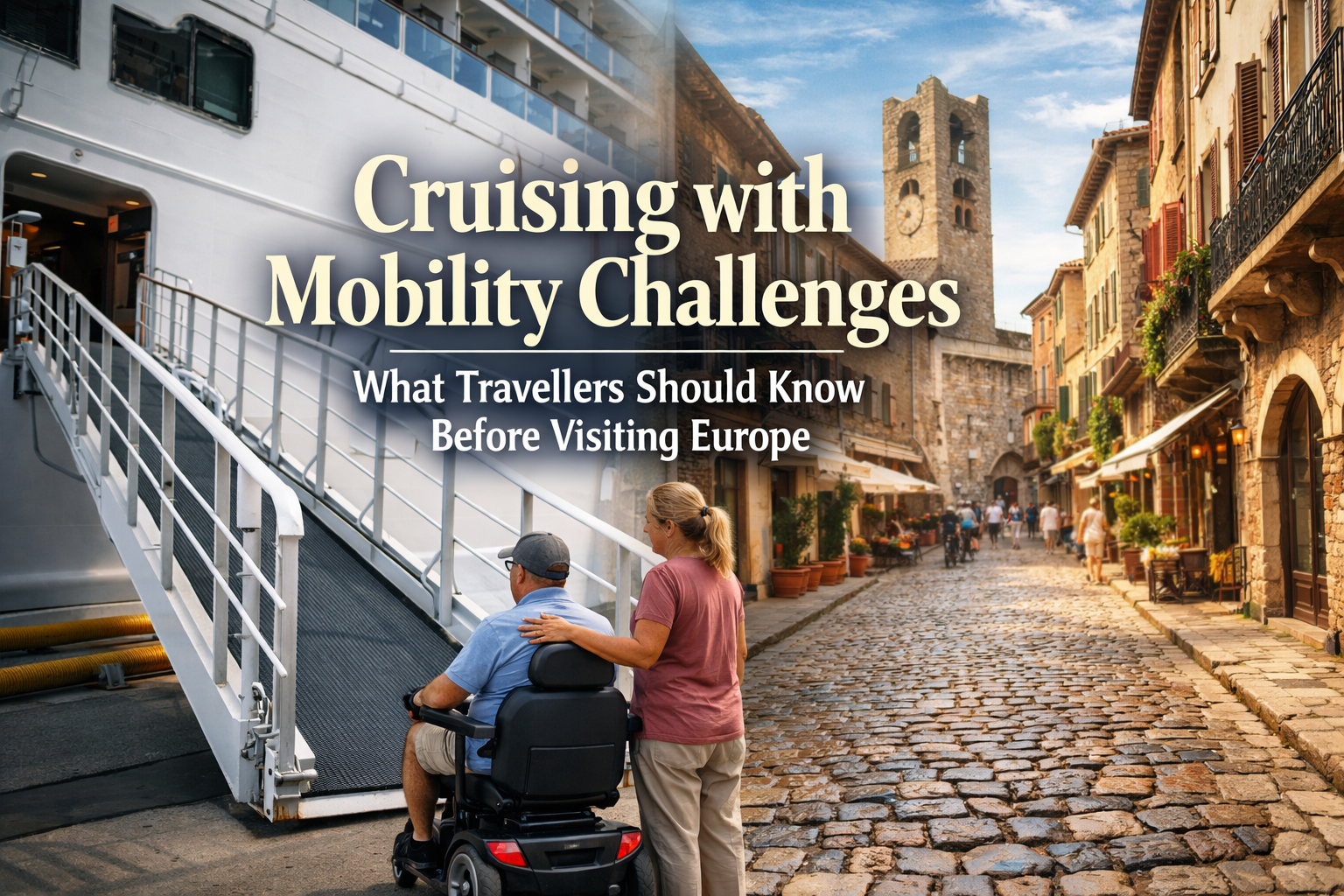
Travel is one of life’s great joys. It opens doors to culture, history, cuisine, and experiences that stay with us forever. For many travellers with mobility challenges, cruising has become one of the most appealing ways to see the world. Ships provide accommodation, dining, and transportation in one place, often making travel easier than traditional land-based trips.
But there is an important reality that travellers should understand before embarking on a cruise to Europe, Asia, or other historic destinations around the world.
Accessibility standards outside North America can be very different from what we are used to at home.
The World Is Not Equally Accessible Everywhere
In North America, accessibility standards have improved dramatically over the past several decades. Ramps, elevators, accessible washrooms, curb cuts, and wide doorways are common in public buildings. Travellers who rely on wheelchairs, scooters, walkers, or canes often expect similar conditions everywhere.
However, many destinations around the world were built centuries before accessibility standards existed and there are no laws forcing these accessibility standards.
European cities are filled with medieval streets, narrow walkways, ancient staircases, and historic buildings protected by preservation laws. Many sidewalks are uneven, cobblestone streets are common, and older buildings may have steps but no ramps. Handrails may be missing, and elevators are often rare in historic districts, and some are so small, they only allow for one or two people standing, and may not accommodate a larger wheelchair. In parts of Asia and other regions, travellers may also encounter squat toilets, steep stairways, or public spaces not designed for wheelchair access.
These places are not intentionally excluding travellers with disabilities. In many cases they simply reflect the preservation of history.
I once heard a traveller ask a guide in a European city why the cobblestone streets were not paved over to make walking easier. The guide paused for a moment and replied thoughtfully: these streets have been here for more than one thousand years. They are part of our history. We would never pave over them.
That moment captured the tension between accessibility and preservation that exists in many parts of the world.
We arrive in destinations with expectations that conditions will be like home. Often they are not, and it is just a part of travel that we must accept.
Cruises Can Be Accessible, But Ports Are Different
Cruise ships themselves have made significant progress in accessibility. Most modern ships offer accessible staterooms, elevators, wide corridors, and accessible public spaces. Mobility devices such as wheelchairs and scooters are commonly used on board, and cruise lines generally accommodate them with planning.
Many travellers with limited mobility actually find cruises to be one of the easiest ways to travel. In surveys of cruise passengers with mobility limitations, a large majority report satisfaction with the assistance provided on board ships.
My personal observations with smaller ships and river cruises especially, is that ship gangways are not always ramps. Sometimes they are stepped and not accessible to a wheelchair. Often river longships “raft” in port and that could mean moving through one or two other ships to get to your ship. This is not a flat and clear path off or on your ship, rather a series of steps and short connecting gangways. These are not wheelchair friendly. I have also personally witnessed that ship Crew do not actively engage to help with this kind of embarkation and disembarkation, and that the individual that needs assistance must have family or friends with them to assist. This can be a liability and health and safety thing for ship's crew.
However, the biggest challenges usually arise once the ship reaches port.
Historic towns often have uneven surfaces and steep streets. Shops, cafés, and small restaurants may have steps at the entrance. Museums and historic sites may involve stairs or narrow passageways. Even when transportation is available, many shore excursion coaches are not equipped with wheelchair lifts.
In some ports, passengers must also use small tender boats to reach shore. Motorized wheelchairs and scooters often cannot be taken on these tenders unless special roll-on capability exists, which is not guaranteed, and actually rare.
Mobility Devices and Cruise Line Policies
Most cruise lines allow guests to bring manual wheelchairs, power wheelchairs, or mobility scooters on board. However, there are limitations that travellers should understand in advance. NOTE that many cruise lines require you to disclose the size and type of wheelchair or scooter in advance when booking, and some cruise lines do not allow or have limited bookings available for guests using wheelchairs.
Accessible staterooms are limited in number and must often be reserved early. Certain scooters or wheelchairs that exceed size limits may require accessible cabins or may not fit through standard cabin doors. In some cases, oversized devices could even prevent boarding if they cannot safely be accommodated. Most cruise lines do not allow the scooter or wheelchair to be left in the corridor, so they must be kept in the small cabin often taking up much of the free space.
River cruises can present additional challenges. Because river ships are smaller and docking conditions change frequently, some European river cruise operators restrict or discourage large mobility scooters entirely. Additionally, if the river cruise line does allow a manual wheelchair, or you rely on a cane or a walker, you must be aware that often the elevators on a river ship do not go to the lowest deck – where there are cabins – or to the sundeck on the top of the ship. If you are not capable of climbing stairs, then you will not have access to these decks.
These policies are not intended to exclude travellers. They exist because of physical limitations of ships, safety requirements, and emergency evacuation procedures.
The Importance of Planning Ahead
For travellers with mobility limitations, the most important step is planning ahead.
This is where speaking with an experienced Travel Advisor can make a significant difference. A knowledgeable advisor can help identify:
Unfortunately, much of this information is not always obvious when travellers book trips online. Details about accessibility are often provided later in the booking process, when changing plans becomes more difficult.
Having these conversations early allows travellers to choose the right cruise, the right ship, and the right destinations for their specific mobility needs.
Travel Should Still Be Possible
Mobility challenges should never mean that travel dreams must end.
Cruising continues to evolve and accessibility is improving across the travel industry. Ships are being designed with better access, ports are gradually improving infrastructure, and tour operators are developing excursions specifically designed for travellers with limited mobility. It may be that you have to consider newer ships as older ships may be more difficult to accommodate a scooter or motorized wheelchair.
Recently I watched a couple that were both reliant on scooters to move about the ship have a very difficult time rolling on and off the elevators as the elevator lobbies were too narrow to give a decent turning radius. It was actually quite disheartening to watch, but even a bystander could not help because there just was not enough space. This ship was launched over 20 years ago, and just not designed with mobility restrictions in mind.
The reality remains that the world does not yet offer the same level of accessibility everywhere.
Understanding that reality ahead of time helps travellers avoid frustration and instead focus on destinations and experiences that truly work for them.
The goal is not to limit travel. The goal is to make travel possible.
With the right planning, the right expectations, and the right guidance, travellers with mobility challenges can still explore the world in meaningful and rewarding ways.
And sometimes the best journeys are the ones thoughtfully designed to match each traveller’s needs.
Ken Graham
Travel Advisor
TravelOnly With Ken
A practical look at how physically demanding Arctic expedition cruising really is, and why most travellers find it fa... learn more
"Europe Sud"
 Ken Graham
Sign up for our newsletter to learn about the latest product news and deals. Also receive exclusive offers, contest details and giveaways.